
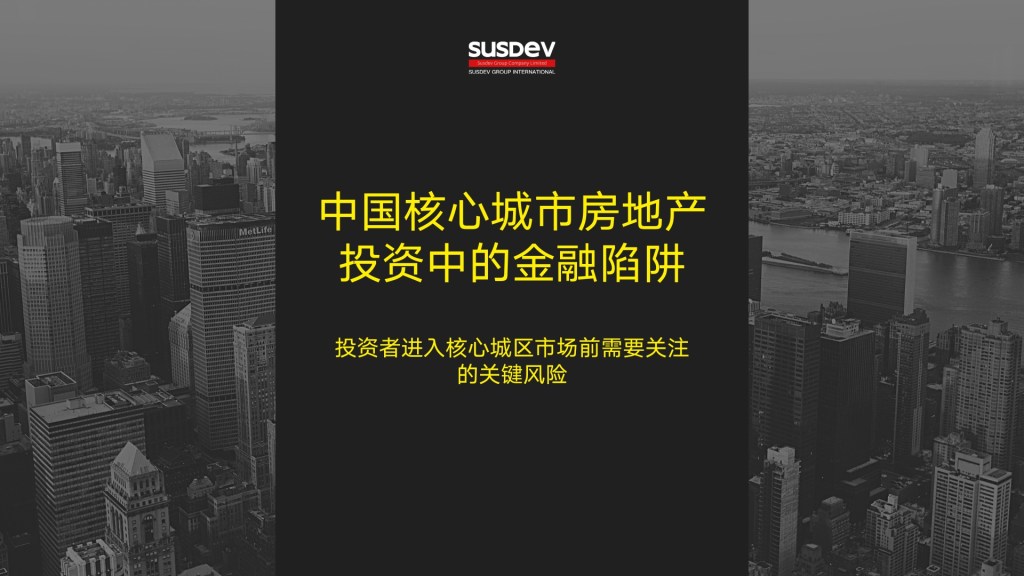
China’s major central urban areas continue to attract significant attention from property investors due to their economic importance, infrastructure, business concentration and long-term development potential. However, high property values and strong investor interest can also create a range of financial risks that are not always immediately visible at the point of purchase.
For investors considering properties in the central districts of major Chinese cities, the headline purchase price is only one part of the financial equation. Financing structure, leverage, transaction costs, liquidity, rental income, taxation, property management expenses and exit conditions can have a substantial impact on the actual investment return.
One of the most common financial traps is overestimating the ability of a prime-location property to generate short-term capital appreciation. A property may be located in a prestigious central district, but location alone does not guarantee that its market value will continue to increase. Changes in supply, demand, interest rates, economic conditions and buyer sentiment can significantly influence liquidity and pricing.
Another important risk is excessive leverage. Investors who rely heavily on borrowing may achieve higher returns when prices rise, but the same structure can amplify losses when market conditions deteriorate. Financing costs, refinancing conditions and repayment schedules should therefore be assessed before any acquisition decision is made.
Rental yield is another area that requires careful examination. High-value properties in central business districts may command significant rents, but a high rental price does not necessarily translate into an attractive net yield. Vacancy periods, management fees, maintenance costs, taxes, financing expenses and other operating costs can materially reduce the actual return received by the owner.
Investors should also pay close attention to transaction liquidity. Prime properties can sometimes appear highly liquid because of their prestigious locations, yet individual assets may require substantial time to sell, particularly during a period of market adjustment. A valuation based on recent transactions should therefore be distinguished from the price that an owner can realistically achieve within a specific timeframe.
Another potential financial trap involves properties marketed primarily on future development expectations. Infrastructure improvements, commercial projects, redevelopment plans and changes in surrounding land use may create long-term opportunities, but projected future value should not automatically be treated as guaranteed appreciation.
For international investors, currency exposure is an additional consideration. Changes between the investor’s home currency and the relevant Chinese currency can affect the final investment return, even when the underlying property maintains its local-currency value.
Susdev Group believes that investment decisions in central Chinese property markets should be based on an asset-specific assessment rather than a simple assumption that prime location equals guaranteed value growth.
A comprehensive investment review should consider acquisition price, financing structure, comparable transactions, rental income, operating expenses, legal and ownership conditions, liquidity, taxation, currency exposure and realistic exit scenarios.
The objective is not simply to identify properties with attractive headline valuations, but to understand the complete financial structure behind the asset and determine whether the investment remains sustainable under different market conditions.
For investors evaluating central urban property in China, disciplined financial analysis and independent due diligence remain essential tools for protecting capital and identifying sustainable long-term opportunities.















 Phu Khai Group