
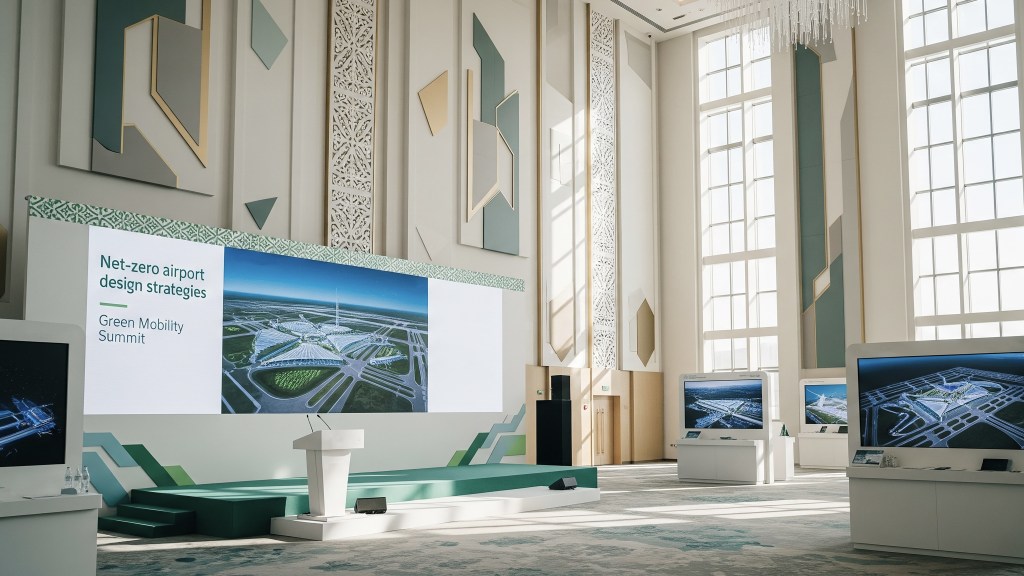
On May 25th 2025 SusAir participated in the Astana Green Mobility Summit presenting its latest research paper titled “Strategies for Net-Zero Airport Infrastructure in Emerging Urban Hubs.” The presentation reflects SusAir’s growing role as a thought leader in sustainable airport development and highlights its commitment to advancing climate-positive design practices across the aviation sector.
Hosted by the Kazakhstan Ministry of Transport in collaboration with international climate agencies the summit brought together policymakers engineers architects and sustainability experts to discuss next-generation mobility systems. The event served as a key global platform for sharing actionable insights on how transportation infrastructure can lead the shift toward carbon neutrality.
Redefining Sustainability in Airport Design
SusAir’s research focuses on an integrated framework for achieving net-zero emissions in airport environments without compromising operational performance or user experience. The study proposes a three-layer strategy: smart energy ecosystems that optimize on-site generation and consumption passive and climate-adaptive architecture that reduces cooling and heating loads and material circularity that minimizes embedded carbon through lifecycle design.
“We believe that the airport of the future is not only a gateway for movement but also a micro-city that regenerates the environment and supports social well-being” said Ms. Pham Ngoc Anh Thi Chairman of the Board and Chief Executive Officer of Susdev Group. “This research is an invitation to rethink airports as proactive agents of climate resilience.”
The paper further emphasizes the need to integrate renewable energy systems such as photovoltaic panels green hydrogen storage and kinetic energy recovery into airport design from the conceptual stage. It also explores the application of AI to manage peak demand energy loads and thermal zoning in large terminals.
Engagement and Impact at the Summit
During the summit SusAir participated in a panel discussion titled “Sustainable Megahubs: Scaling Green Aviation” alongside representatives from the ICAO World Bank and major airport authorities from Asia and Europe. The panel examined how cities can align airport development with national climate targets and urban regeneration goals.
Attendees engaged with SusAir’s interactive digital models that illustrated design simulations of net-zero terminal concepts under varying climatic and urban conditions. The models were praised for their clarity feasibility and user-oriented design narrative.
The summit also opened doors for future collaboration between SusAir and academic institutions including Nazarbayev University and international research labs where joint research on smart climate data integration for airports is being explored.
Building a Future Beyond Carbon
For SusAir the Astana summit was more than just a presentation opportunity. It was a moment to reinforce its philosophy that sustainability is not an add-on but the foundation of infrastructure innovation.
The research presented will form part of SusAir’s internal design guidelines and continue to shape its contributions to international dialogues on resilient mobility. As SusAir progresses from research to design development it remains committed to ensuring that airports of tomorrow meet the needs of both people and the planet.





 Vertel Corporation