
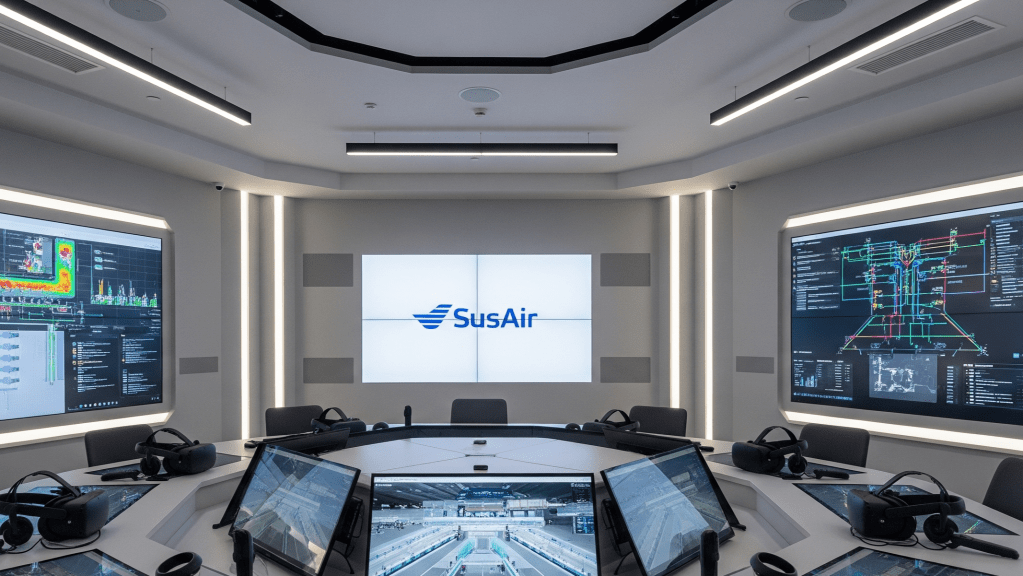
On February 19th 2025 SusAir organized an exclusive closed-door workshop titled “Dynamic Passenger Flow and Terminal Morphology” at its Astana headquarters. The event gathered a select group of aviation planners systems engineers and behavioral researchers to examine how new passenger movement models can reshape airport terminal design from a systems perspective.
This internal workshop is part of SusAir’s core R&D initiatives for 2025 focusing on human-centric planning methods that respond to the changing nature of mobility technologies global travel patterns and the post-pandemic behavioral landscape. Unlike traditional summits or public exhibitions the event prioritized long-form peer discussions and model testing in a private and deeply focused environment.
A Systems Approach to Movement
The workshop opened with a keynote session led by Dr. Timur Sarsenbayev Head of Human Systems Lab at SusAir who introduced the team’s evolving framework for passenger typology mapping and spatial response modeling. His presentation emphasized the need for airport design to move beyond static circulation assumptions and toward real-time adaptive systems capable of learning from behavioral data and reshaping flows through dynamic environments.
The team demonstrated several simulation environments built in-house using agent-based modeling tools where synthetic passengers interacted with responsive architectural zones. Variables like movement efficiency dwell time crowd response and visual wayfinding were continuously measured and optimized.
“Our airports must learn to breathe with the flow of humanity not control it” Dr. Timur said. “By letting form follow pattern we give passengers back the intuitive sense of direction comfort and space they seek.”
Outcomes and Next Steps
Participants collaborated in small groups to challenge current assumptions about security processing gate proximity and service node distribution. Through hands-on interaction with VR and data-driven floorplate models participants explored new morphologies that adapt to shifts in airline operations passenger age groups and AI-integrated scheduling.
One of the highlights was a prototype concept for a modular terminal that changes its physical layout throughout the day based on predictive crowding thresholds and gate activity. The concept is now being refined by SusAir’s design systems unit for potential publication in Q3 2025.
Although the workshop was not open to the public SusAir confirmed that findings from this session will feed directly into its open-access Insight Reports in the coming months. It also hinted at a larger symposium on “Human Flow Futures” scheduled for early 2026.
A Quiet but Impactful Milestone
While less visible than public exhibitions SusAir’s internal workshops serve as the engine room of its innovation process. They reflect the company’s belief that long-term impact in airport design requires meticulous research rigorous critique and focused experimentation.
As SusAir continues to explore the boundaries of infrastructure and behavior the February 2025 workshop marks another important step in aligning people systems and architecture toward a shared future of meaningful travel.




 Vertel Corporation